
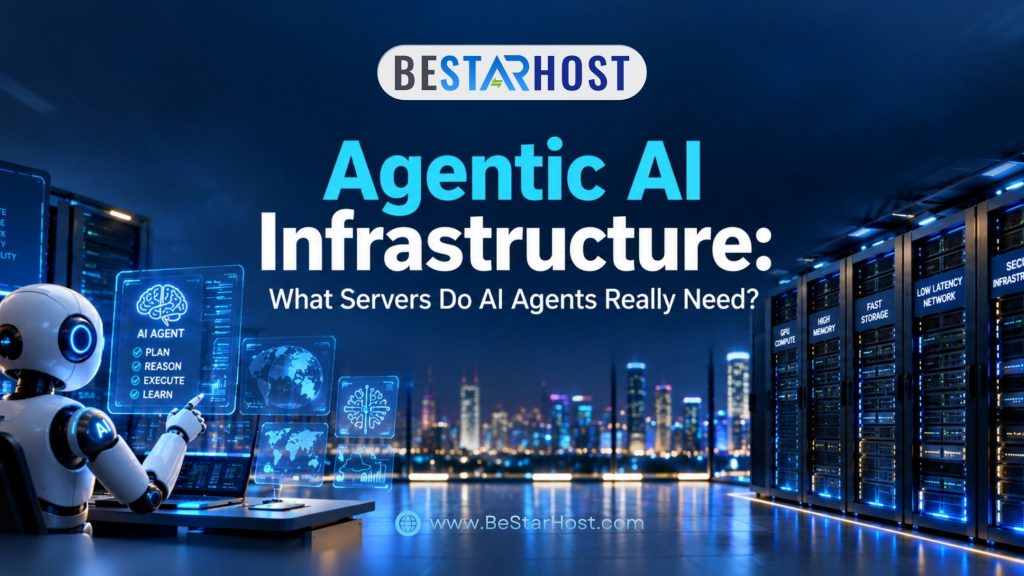
 A chatbot answers a question and the request is over. An AI agent plans a multi-step task, calls tools, executes code, reads the result, decides what to do next, and repeats that loop — sometimes dozens of times — before it’s actually done. That difference sounds small in a product demo and turns out to be enormous in infrastructure terms. Agentic AI infrastructure has to support execution, state, and orchestration in ways a simple inference endpoint never had to.
This guide covers what AI agent infrastructure genuinely requires — sandboxed execution, persistent state, orchestration across sub-agents and tools, and the cost realities of a workload that makes far more model calls than it looks like from the outside. If your agents call external tools through a standardized interface, it’s worth pairing this with our guide to Model Context Protocol (MCP) and why modern AI agents need the right hosting infrastructure, since MCP is quickly becoming the standard connective layer between agents and the tools they use.
Why Agents Break the Assumptions Behind Typical AI Hosting
Most AI hosting guidance — including our own on AI inference hosting — assumes a request comes in, the model responds, and the transaction is done. Agentic workloads violate every part of that assumption:
- One user action can trigger dozens of model calls — an agent planning a task, calling a tool, evaluating the result, and re-planning generates far more inference volume per user interaction than a single chat response.
- Execution has to happen somewhere — when an agent decides to run code, query a database, or call an API, that action needs a real, secured execution environment, not just another inference call.
- State has to persist across the whole task — a multi-step agent needs to remember what it already tried, what succeeded, and what the current plan is, often across a session that runs far longer than a typical request-response cycle.
- Multiple agents may run concurrently or hierarchically — a planner agent delegating to specialized sub-agents multiplies both the orchestration complexity and the underlying resource demand.
Sandboxed Execution: The Part Most Teams Underestimate
The moment an agent can execute code or run shell commands on your behalf, that execution environment becomes a genuine attack surface — whether the risk comes from a prompt injection, a bug in the agent’s reasoning, or an over-broad tool permission. This is the same concern covered in more depth in our guide on building a secure AI coding environment using dedicated servers, and it applies directly to autonomous agents, not just AI coding assistants:
- Isolated execution sandboxes — agent-executed code should run in a container or microVM isolated from the host system and from other agents’ sessions, so a runaway or compromised agent can’t affect anything beyond its own sandbox.
- Resource limits per sandbox — CPU, memory, and execution time limits on each sandbox prevent one misbehaving agent task from starving others or running indefinitely.
- Network egress control — an agent’s sandbox should only be able to reach the specific tools and APIs it’s actually authorized to call, not the open internet by default.
- Ephemeral by default — sandboxes that are destroyed and recreated per task avoid state leaking between unrelated agent sessions.
Orchestration: Coordinating Agents, Tools, and Sub-Agents
AI orchestration for agentic systems has to manage more moving pieces than a typical microservices deployment:
- Task queuing and scheduling — agent tasks vary wildly in duration, from seconds to many minutes; a scheduler needs to handle this variability without starving short tasks behind long-running ones.
- Sub-agent lifecycle management — hierarchical agent systems (a planner spinning up specialized workers) need clean spin-up, monitoring, and teardown for sub-agents, ideally using the same container orchestration discipline covered in our comparison of Kubernetes vs Docker Swarm for dedicated servers.
- Retry and failure handling — a tool call or sub-agent step failing shouldn’t necessarily fail the entire task; orchestration needs a policy for retries, fallbacks, and when to surface a failure versus silently retrying.
- Observability across the whole task graph — debugging why an agent took a particular action requires tracing the full sequence of model calls, tool invocations, and intermediate results, not just a single request/response log line.
State and Memory: What Persists, and Where
Agentic tasks need working memory that survives across the full task lifecycle, which introduces infrastructure decisions a stateless API never had to make:
- Short-term task state — the current plan, intermediate results, and tool call history for an in-progress task, typically held in fast storage like Redis for quick read/write access during the active session.
- Long-term memory — some agent architectures persist learned context or user preferences across sessions, often backed by a vector store for semantic retrieval — the same infrastructure discussed in our guide to hosting vector AI APIs with FastAPI.
- Durability requirements — a long-running agent task that crashes partway through ideally resumes from its last known state rather than restarting from scratch, which means task state needs to survive a process restart, not just live in memory.
The Cost Reality: Agents Are Not Cheap to Run
Because a single user-facing “task” can translate into many underlying model calls, tool invocations, and sandbox executions, AI workloads built around agents tend to cost meaningfully more per interaction than a simple chat response — and the cost is easy to underestimate until it’s already in production:
- Multiply, don’t estimate linearly — a task that takes an agent five reasoning-and-tool-call cycles to complete isn’t five times the cost of one inference call in a simple sense; retries, re-planning, and verification steps commonly push real-world multipliers higher than initial estimates.
- Caching still applies, but less cleanly — the response caching techniques covered in our AI inference hosting guide help less here, since agent reasoning paths are rarely identical between runs even for similar-looking tasks.
- Sandboxed execution has its own compute cost — beyond model inference, every code execution or tool call sandbox consumes real CPU and memory, which needs to be budgeted separately from inference cost.
Autonomous AI and Autoscaling: A Genuine Tension
Autonomous AI workloads are inherently bursty — agent usage tends to spike unpredictably around specific workflows or triggers rather than following a smooth, predictable traffic pattern. This creates real tension between two valid infrastructure strategies:
- Elastic, cloud-burst capacity — handles unpredictable spikes well, but per-use billing on execution sandboxes and inference calls can get expensive fast given how many calls a single agent task can generate.
- Dedicated baseline capacity — a fixed pool of dedicated compute for steady-state agent load, with burst capacity reserved for genuine spikes, tends to be more cost-predictable for teams running agents at consistent volume — the same fixed-cost-versus-metered reasoning covered in bare metal servers vs cloud VMs for high-performance applications.
Securing Agent Credentials and Tool Access
Agents frequently hold credentials for every tool and API they’re authorized to call — which means a single compromised or misdirected agent can potentially touch far more systems than a typical application would. The discipline covered in secrets management for production servers: protect API keys and AI credentials matters more here, not less: scope each agent’s tool credentials to the minimum required for its specific role, and avoid a single set of broad credentials shared across every agent in a system.
How BeStarHost Supports Agentic AI Infrastructure
Agentic workloads need dedicated, sandboxed execution capacity alongside inference — not just a bigger inference server:
- Dedicated servers with guaranteed, unshared CPU and RAM for both inference and sandboxed code execution, avoiding contention between the two very different workload types agents generate.
- NVMe storage across server tiers, keeping sandbox spin-up and vector-backed memory retrieval fast.
- Dedicated, unshared bandwidth on a global low-latency network, relevant for the high volume of tool and API calls a multi-step agent task generates.
- 99.9% uptime on Tier 3 / Tier 4 hardware with RAID 0 / RAID 1 configurations.
- IPMI KVM-over-IP for direct remote access when configuring sandbox isolation or orchestration infrastructure.
- 14 global data center locations across Europe (France, Germany, Netherlands, United Kingdom), Asia (Singapore, Hong Kong, India, South Korea, Taiwan, Philippines, Myanmar, Cambodia), and North America (United States, Canada) — letting you place agent infrastructure close to your users and the tools your agents call.
- No setup fees and 24/7/365 support if you need help architecting a dedicated baseline for agentic workloads.
Explore our dedicated server plans, read more on our About Us page, or contact our team to scope infrastructure for your agentic AI system.
Frequently Asked Questions
Why does an AI agent cost more to run than a chatbot?
A single agent task typically involves multiple reasoning steps, tool calls, and re-planning cycles rather than one model call and response. Each of these steps consumes inference and, often, separate sandboxed execution resources, meaning the real cost multiplier per user interaction is usually higher than it initially appears.
Do AI agents need sandboxed execution environments?
Yes, for any agent capable of executing code or running commands on your behalf. Isolated sandboxes with resource limits and restricted network egress prevent a compromised or misbehaving agent from affecting the host system, other agent sessions, or systems beyond what it’s explicitly authorized to reach.
What’s the difference between short-term and long-term agent memory?
Short-term memory holds the current task’s working state — plans, intermediate results, and tool call history — typically in fast storage for the duration of an active session. Long-term memory persists context or preferences across separate sessions, often backed by a vector store for semantic retrieval of relevant past information.
Should agentic AI infrastructure use dedicated servers or cloud autoscaling?
It depends on usage pattern. Elastic cloud capacity handles unpredictable spikes well but can become expensive given how many calls a single agent task generates. Dedicated baseline capacity is typically more cost-predictable for steady-state agent workloads, often combined with burst capacity reserved for genuine spikes.
What happens if an agent task fails partway through?
Well-designed agent orchestration persists task state durably enough to resume from the last known step rather than restarting from scratch, and includes a defined retry and fallback policy so that a single failed tool call or sub-agent step doesn’t necessarily fail the entire task.
Architecting infrastructure for autonomous AI agents at scale? Talk to BeStarHost about dedicated servers built for agentic AI workloads →