
Training a model happens once. Inference happens every single time someone uses it — which means AI inference hosting is where most of the ongoing cost, and most of the user-facing latency, actually lives in a production AI system. Teams that optimize training but leave inference on default settings routinely end up paying multiples of what they need to, while users wait longer than necessary for responses that could have been served in a fraction of the time.
This guide covers the practical levers that actually move inference hosting cost and speed: batching, quantization, KV cache management, and how to choose between serving frameworks and hosting models. If you’re serving inference behind a REST API, it’s worth pairing this with our guide to hosting vector AI APIs with FastAPI, since the API layer and the inference layer share several of the same bottlenecks.
Where Inference Cost Actually Comes From
Three factors dominate AI inference server economics, and they trade off against each other constantly:
- Compute utilization — GPUs are expensive whether they’re busy or idle; the goal of most inference optimization is keeping expensive hardware as consistently utilized as possible without hurting response times.
- Memory bandwidth and capacity — modern LLM inference is frequently memory-bandwidth-bound rather than purely compute-bound, meaning how fast data moves in and out of GPU memory often matters as much as raw compute throughput.
- Request latency requirements — a chat interface where users are actively waiting has very different acceptable latency than a batch job processing documents overnight, and the right cost optimization strategy depends entirely on which one you’re serving.
Batching: The Single Highest-Leverage Optimization
Processing multiple inference requests together instead of one at a time is consistently the biggest lever for LLM inference throughput:
- Static batching — groups a fixed number of requests together before processing, simple to implement but wastes GPU cycles waiting for a batch to fill or holds shorter requests hostage to longer ones finishing.
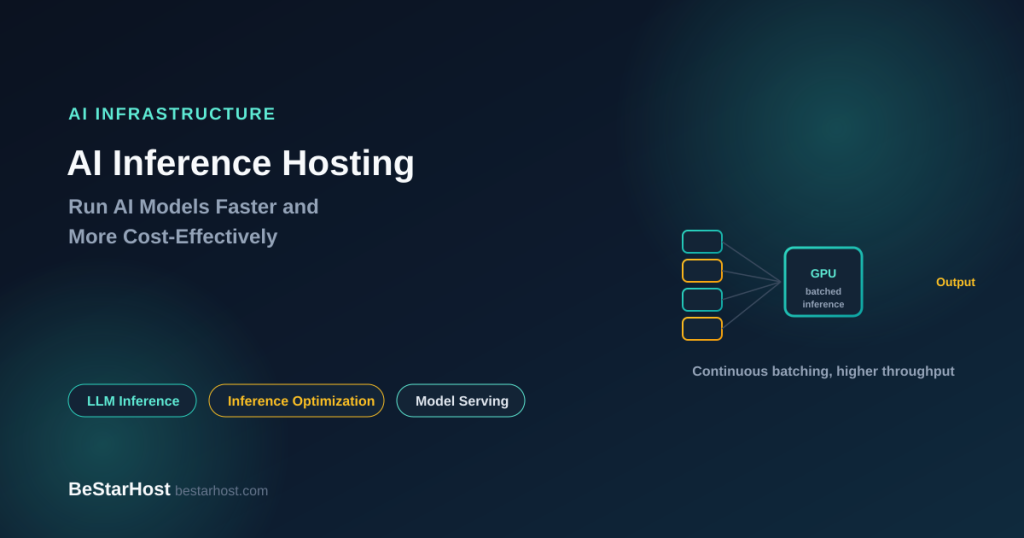
- Continuous (dynamic) batching — newer serving frameworks add and remove requests from an in-flight batch dynamically as they arrive and complete, dramatically improving GPU utilization compared to static batching by avoiding idle time between batches.
- Throughput vs latency tradeoff — larger batches generally improve total throughput (requests served per second across all users) but can increase per-request latency for any individual request, since it may share compute with more concurrent requests; the right batch size depends on whether the deployment prioritizes aggregate throughput or individual response speed.
Quantization: Trading Precision for Speed and Memory
Running a model at lower numerical precision (8-bit or 4-bit instead of 16-bit or 32-bit) reduces both memory footprint and, on hardware with appropriate support, compute time:
- Memory savings — a quantized model requires proportionally less GPU memory to load, directly enabling larger models to fit on the same hardware, or more concurrent capacity for a given model size.
- Quality tradeoff — more aggressive quantization can measurably degrade output quality on some tasks; the right quantization level should be validated against representative evaluation data for the specific use case, not assumed to be safe by default.
- Hardware-dependent speedups — quantization’s compute speed benefit depends on the specific GPU’s support for lower-precision operations; the memory savings are more universally applicable than the compute speedup.
KV Cache Management
For transformer-based LLM inference, the key-value (KV) cache — which stores intermediate attention state so it doesn’t need recomputing for every new token — is one of the largest and most easily overlooked memory consumers:
- KV cache scales with context length and concurrent requests — longer conversations and more simultaneous users both directly increase KV cache memory demand, often more than the base model weights themselves at scale.
- Efficient KV cache memory management — modern serving frameworks implement paged or block-based KV cache allocation (conceptually similar to virtual memory paging in operating systems) to reduce memory fragmentation and support significantly more concurrent sequences than naive, contiguous allocation.
- Cache eviction and prefix sharing — some frameworks can share KV cache across requests with identical prompt prefixes (a common pattern in RAG or system-prompt-heavy applications), avoiding redundant computation for shared context.
Choosing a Serving Framework
The serving layer sitting between raw model weights and an API endpoint has matured substantially, and the choice affects both throughput and operational complexity:
- vLLM — widely adopted for its continuous batching and efficient (PagedAttention-based) KV cache management, generally delivering strong throughput for high-concurrency LLM serving.
- Text Generation Inference (TGI) — Hugging Face’s production serving toolkit, with broad model compatibility and built-in support for common production concerns like streaming responses and quantization.
- NVIDIA Triton Inference Server — a more general-purpose serving platform supporting multiple model frameworks and formats beyond just LLMs, often the right choice when a deployment needs to serve varied model types rather than LLM inference alone.
Each abstracts away meaningful engineering effort — hand-rolling continuous batching and efficient KV cache management from scratch is a substantial undertaking most teams shouldn’t take on unless they have very specific requirements these frameworks don’t meet.
AI Model Serving: Caching Beyond the KV Cache
Beyond the model’s internal KV cache, an application-level response cache catches an entirely different kind of redundancy — repeated or near-identical requests that don’t need fresh inference at all:
- Exact-match response caching — caching final responses by request hash avoids recomputation for genuinely duplicate queries.
- Semantic caching — matching by embedding similarity rather than exact text catches near-duplicate queries an exact-match cache would miss.
See our comparison of Redis vs Memcached for high-traffic websites for which caching layer fits this pattern best — this application-level cache sits above the serving framework and is complementary to, not a replacement for, the framework’s own internal KV cache optimizations.
Hardware Choices: GPU Sizing for Inference
Inference hardware requirements differ meaningfully from training hardware requirements — inference is typically far less compute-intensive per request but far more sensitive to memory capacity and bandwidth for serving concurrent users:
- VRAM capacity caps concurrent load — the model’s base memory footprint plus KV cache overhead per active request determines how many simultaneous conversations a given GPU can actually serve before running out of memory.
- Memory bandwidth affects token generation speed — for many LLM inference workloads, especially at smaller batch sizes, how fast the GPU can read model weights from memory limits token generation speed more than raw compute throughput does.
- Multi-GPU setups for larger models — models too large for a single GPU’s memory require sharding across multiple GPUs, which introduces inter-GPU communication overhead that itself needs fast, low-latency interconnects to avoid becoming its own bottleneck.
Dedicated Inference Infrastructure vs Pay-Per-Token APIs
Hosted inference APIs remain the simpler default for low or unpredictable volume — no infrastructure to manage, and cost scales down to zero when unused. The calculus shifts once usage becomes sustained and high-volume:
- Fixed cost beats metered billing at scale — the same reasoning covered in bare metal servers vs cloud VMs for high-performance applications applies directly here: a dedicated GPU server’s fixed monthly cost becomes cheaper than per-token billing once request volume crosses a predictable threshold.
- Full control over the serving stack — self-hosted inference allows choosing quantization level, batching strategy, and serving framework precisely, rather than accepting whatever tradeoffs a third-party API has already made on your behalf.
- Data never leaves your infrastructure — relevant for the same reasons covered in our guide to self-hosting Open WebUI with Ollama, where data residency and privacy requirements make hosted APIs a non-starter regardless of cost.
Securing Inference Infrastructure
Inference endpoints are frequently gated by API keys, both for inbound authentication and for any external services the pipeline calls. The same discipline covered in secrets management for production servers applies directly — credentials should be scoped narrowly and never leak into logs, especially in inference pipelines that log request/response pairs for debugging or evaluation purposes.
How BeStarHost Supports AI Inference Hosting
Cost-effective, fast inference depends on real, unshared compute and memory capacity underneath whatever serving framework and optimization strategy you choose:
- Dedicated servers with guaranteed, unshared CPU and RAM, so batching and concurrency tuning aren’t undermined by another tenant’s contention.
- NVMe storage across server tiers, keeping model loading fast when switching between models or scaling up new inference nodes.
- Dedicated, unshared bandwidth on a global low-latency network, relevant for both API-facing latency and multi-node inference setups.
- 99.9% uptime on Tier 3 / Tier 4 hardware with RAID 0 / RAID 1 configurations.
- IPMI KVM-over-IP for direct remote access when configuring serving frameworks or tuning batching parameters.
- 14 global data center locations across Europe (France, Germany, Netherlands, United Kingdom), Asia (Singapore, Hong Kong, India, South Korea, Taiwan, Philippines, Myanmar, Cambodia), and North America (United States, Canada) — letting you place inference servers close to your users to cut round-trip latency.
- No setup fees and 24/7/365 support if you need help sizing infrastructure for a production inference deployment.
Explore our dedicated server plans, read more on our About Us page, or contact our team to scope infrastructure for your inference workload.
Frequently Asked Questions
What is the biggest factor in AI inference cost?
GPU utilization is usually the dominant factor — hardware is expensive whether it’s actively processing requests or sitting idle, so the goal of most inference optimization is keeping compute consistently utilized through techniques like continuous batching, rather than reducing raw compute demand alone.
What is continuous batching and why does it matter for LLM inference?
Continuous batching dynamically adds and removes requests from an in-flight processing batch as they arrive and complete, rather than waiting for a fixed batch to fill. This significantly improves GPU utilization compared to static batching, which leaves the GPU idle while waiting for enough requests to accumulate.
Does quantization hurt AI model output quality?
It can, depending on how aggressive the quantization is and the specific task. Quantization should be validated against representative evaluation data for the intended use case rather than assumed safe by default, since some tasks are more sensitive to reduced numerical precision than others.
What is the KV cache in LLM inference?
The key-value (KV) cache stores intermediate attention state from previous tokens so it doesn’t need to be recomputed for every new token generated. It scales with both context length and the number of concurrent requests, and is often one of the largest memory consumers in production LLM serving, sometimes exceeding the memory used by the model weights themselves at scale.
When does dedicated inference hosting make more sense than a pay-per-token API?
Dedicated hosting tends to become more cost-effective once request volume is sustained and high enough that fixed infrastructure costs are lower than metered per-token billing. It also makes sense regardless of volume when data residency requirements mean inference requests cannot be sent to a third-party API at all.
Optimizing inference cost and latency for a production AI workload? Talk to BeStarHost about dedicated servers built for AI inference hosting →