
 Retrieval-augmented generation looks simple in a demo: embed a question, search a vector store, stuff the results into a prompt, and let the model answer. Production RAG hosting is a different problem entirely — it’s a multi-stage pipeline where a slowdown or failure at any single stage degrades the whole system, and where the components have genuinely different, sometimes conflicting, infrastructure requirements.
This guide covers what real RAG infrastructure needs across ingestion, embedding, retrieval, and generation. If you haven’t already sized the vector database layer specifically, start with our guide to vector databases and hosting requirements for AI search applications, since it covers the retrieval layer in more depth than this guide’s broader pipeline view.
The Full RAG Pipeline, and Where Infrastructure Decisions Actually Live
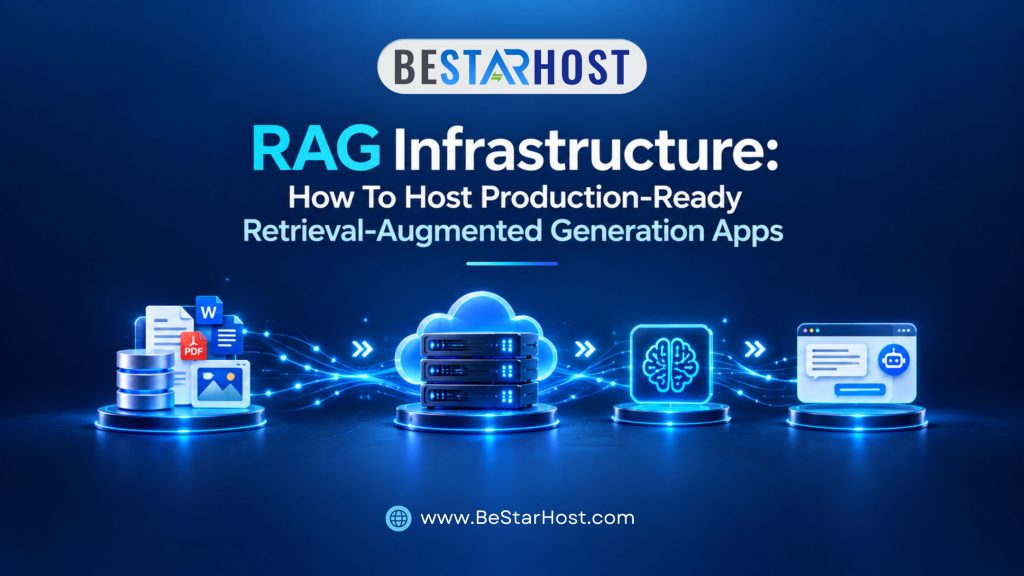
A production RAG system has more moving parts than the demo version suggests:
- Document ingestion and chunking — source documents get split into retrievable chunks, a batch or streaming process with its own compute and storage footprint separate from the live query path.
- Embedding generation — both at ingestion time (for every chunk) and query time (for every incoming question), embedding generation is a genuine inference workload in its own right.
- Vector storage and retrieval — the indexed embeddings need to be queried with low latency at request time, with index size and query patterns driving very different infrastructure needs than the embedding step.
- Context assembly and generation — retrieved chunks get assembled into a prompt and sent to an LLM, which is its own inference call with its own latency and cost profile.
Each of these stages can be the bottleneck depending on your specific system, which is exactly why generic “RAG hosting” advice often falls short — the right infrastructure emphasis depends on where your actual system spends its time.
Embedding Infrastructure: Two Very Different Workload Patterns
Ingestion-time and query-time embedding generation have almost opposite infrastructure profiles:
- Ingestion is throughput-oriented and bursty — processing a large document corpus benefits from batch processing and can tolerate higher latency per chunk, making it a good candidate for scheduled or queued processing rather than always-on capacity.
- Query-time embedding is latency-sensitive — a user waiting on a response needs their query embedded quickly, which argues for keeping the query-time embedding model warm and readily available rather than cold-starting it per request, echoing the model-loading concerns covered in our FastAPI AI hosting guide.
- Separate capacity for each — treating ingestion and query-time embedding as the same workload, sized for the same traffic pattern, tends to either under-provision query-time responsiveness or over-provision idle ingestion capacity.
Vector Database Hosting: Query Latency Under Real Load
Vector database hosting for RAG has a distinct performance profile from a typical database workload:
- Index size drives memory requirements — many vector index structures perform best with the index held largely in memory; a corpus that outgrows available RAM sees a real latency penalty as portions of the index fall back to disk.
- Approximate nearest neighbor tradeoffs — most production vector search uses approximate rather than exact nearest-neighbor search, trading a small amount of retrieval accuracy for dramatically better query latency at scale; the right approximation parameters depend on how much accuracy loss is acceptable for your use case.
- Filtering alongside vector search — real RAG applications frequently need to filter by metadata (document source, date, access permissions) alongside semantic similarity, and this combined filtering can be significantly more expensive than pure vector search alone if the underlying index isn’t built to support it efficiently.
- Fast storage for index persistence — even memory-resident indexes need to persist to disk for durability and fast restart; NVMe storage, covered in our guide to why NVMe storage is essential for modern AI and database workloads, meaningfully reduces both persistence overhead and cold-start rebuild time.
Why Colocation Matters More for RAG Than Most AI Workloads
A single RAG query typically touches the embedding model, the vector database, and the generation model in sequence — meaning network latency between these components is paid on every single request, not just occasionally:
- Co-locate the embedding model and vector database — since query embedding happens immediately before vector search, keeping these two components physically close (ideally the same host or same low-latency network segment) avoids compounding latency across the request’s most time-sensitive path.
- Minimize hops before generation — once retrieval completes, assembling context and calling the generation model should add minimal additional network overhead; this is the same colocation reasoning covered in our guide to reducing AI inference costs with better server architecture, applied specifically to the retrieval-to-generation handoff.
Caching in a RAG Pipeline
RAG introduces caching opportunities at multiple stages, not just at the final response:
- Embedding cache — caching embeddings for frequently repeated or identical queries avoids redundant embedding model calls.
- Retrieval cache — caching the retrieved chunk set for identical or near-identical queries skips the vector search step entirely for repeat questions.
- Full response cache — for genuinely identical queries, caching the final generated response avoids the entire pipeline, though this is the least broadly applicable layer since RAG responses often incorporate freshly retrieved, potentially time-sensitive context.
See our comparison of Redis vs Memcached for high-traffic websites for which caching layer fits each of these stages — the right choice often differs between the embedding cache and the full response cache given their different access patterns.
Freshness: Keeping the Index Current Without Breaking Production
Unlike a static model, a RAG system’s knowledge is only as current as its vector index — which creates an operational challenge most teams underestimate:
- Incremental indexing vs full re-indexing — incrementally adding, updating, or removing individual documents from the index is generally far cheaper than periodically rebuilding the entire index from scratch, and should be the default approach where the vector database supports it.
- Zero-downtime index updates — production RAG systems need a strategy for updating the index without serving degraded or inconsistent results mid-update, often through a blue-green index-swap pattern rather than updating a single live index in place.
- Access control on retrieved content — for multi-tenant RAG applications, retrieval has to respect document-level access permissions, not just semantic relevance; a document a user shouldn’t see must never surface in their retrieved context regardless of similarity score, which is a genuine security control, not just a relevance concern.
Securing a RAG Pipeline
RAG systems introduce a data exposure surface that simpler chatbots don’t have: the documents in the index themselves. The same credential discipline covered in secrets management for production servers applies to whatever data source feeds the ingestion pipeline, and access control on the retrieval layer deserves the same scrutiny as access control on the source documents it was built from — a common and serious RAG security gap is an index that’s more permissive than the documents it was indexed from.
How BeStarHost Supports Production RAG Infrastructure
A RAG pipeline’s multiple stages benefit from infrastructure that can be sized and placed deliberately for each stage’s actual profile, not a single one-size-fits-all instance:
- Dedicated servers with guaranteed, unshared CPU, RAM, and GPU — embedding generation, vector search, and LLM inference each get predictable performance without contention between stages.
- NVMe storage across server tiers, keeping vector index persistence and document ingestion I/O fast.
- Dedicated, unshared bandwidth on a global low-latency network — critical for the embedding-to-retrieval-to-generation path where every network hop compounds into user-facing latency.
- 99.9% uptime on Tier 3 / Tier 4 hardware with RAID 0 / RAID 1 configurations.
- IPMI KVM-over-IP for direct remote access when managing index rebuilds or pipeline configuration.
- 14 global data center locations across Europe (France, Germany, Netherlands, United Kingdom), Asia (Singapore, Hong Kong, India, South Korea, Taiwan, Philippines, Myanmar, Cambodia), and North America (United States, Canada) — letting you co-locate your full RAG pipeline close to your users.
- No setup fees and 24/7/365 support if you need help architecting a production RAG deployment.
Explore our dedicated server plans, read more on our About Us page, or contact our team to scope infrastructure for your RAG application.
Frequently Asked Questions
What are the main components of a RAG infrastructure stack?
A production RAG stack typically includes document ingestion and chunking, an embedding model for converting text to vectors, a vector database for storing and querying embeddings, and a generation model that produces the final response using retrieved context. Each component has distinct performance and scaling characteristics.
Why does colocation matter more for RAG than for a simple chatbot?
A single RAG query sequentially touches the embedding model, vector database, and generation model, so network latency between these components is incurred on every request rather than occasionally. Keeping these components physically close reduces compounding latency across this multi-hop path.
Should a RAG system use exact or approximate vector search?
Most production RAG systems use approximate nearest-neighbor search, which trades a small amount of retrieval accuracy for significantly better query latency at scale. Exact search remains relevant for smaller indexes or applications where retrieval accuracy is more critical than query speed.
How should a RAG system handle documents users shouldn’t have access to?
Retrieval needs to enforce document-level access permissions independently from semantic relevance, ensuring a document a user isn’t authorized to see never surfaces in their retrieved context regardless of similarity score. This is a security control that needs to be built into the retrieval layer itself, not assumed to be handled elsewhere.
Is it better to incrementally update a vector index or rebuild it fully?
Incremental indexing — adding, updating, or removing individual documents — is generally far more efficient than periodically rebuilding the entire index, and should be the default where the vector database supports it. Full rebuilds are typically reserved for structural changes, like migrating to a different embedding model.
Building a production retrieval-augmented generation application? Talk to BeStarHost about dedicated servers built for RAG infrastructure →