
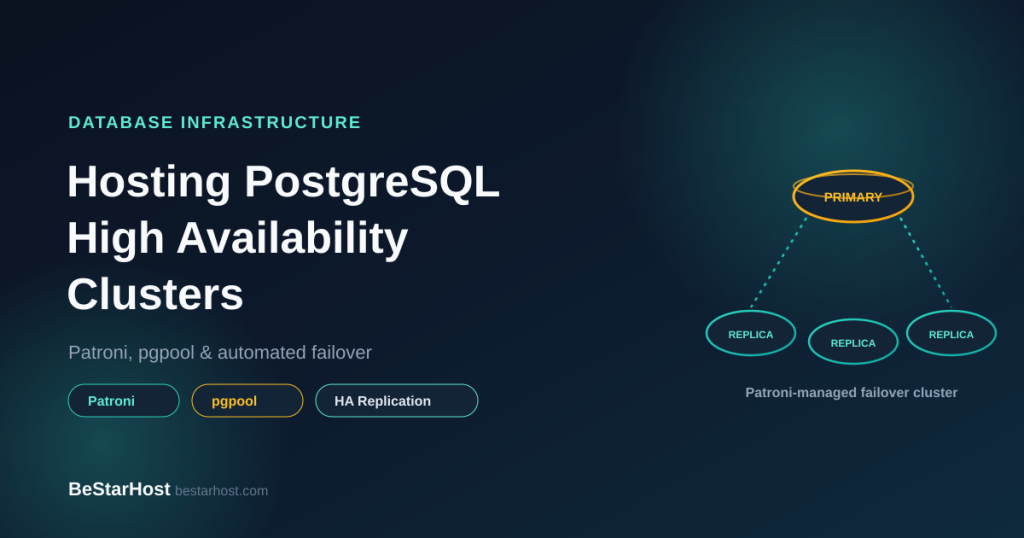
 A single PostgreSQL instance is a single point of failure. For most applications that’s an acceptable risk during development — but the moment a database goes into production for an enterprise workload, “the server didn’t crash last year” stops being a strategy. PostgreSQL HA exists to solve exactly this problem: keep the database available, consistent, and recoverable even when a node, a disk, or an entire data center goes down.
This guide covers what actually goes into a production-grade PostgreSQL clustering setup — PostgreSQL replication models, where Patroni and pgpool fit, and the infrastructure decisions that determine whether your failover takes two seconds or twenty minutes. If you’re weighing where PostgreSQL fits alongside other data infrastructure, it’s worth pairing this with our look at why NVMe storage is essential for modern AI and database workloads, since disk performance shapes replication lag as much as network speed does.
Why PostgreSQL High Availability Is Harder Than It Looks
Unlike stateless application servers, a database can’t just be duplicated and load-balanced arbitrarily — every replica has to stay consistent with a single source of truth, and a failover has to promote a replica without losing committed transactions or creating a split-brain scenario where two nodes both believe they’re primary. That’s what makes enterprise PostgreSQL deployments meaningfully harder to host correctly than the stateless services discussed in our high availability architecture guide for business websites — state has to survive the failure, not just traffic.
PostgreSQL Replication Models
PostgreSQL’s own documentation outlines several replication approaches, but production HA clusters almost always build on one of these:
- Streaming replication (physical) — the standard approach. A replica continuously streams the write-ahead log (WAL) from the primary and replays it, keeping an up-to-date binary copy ready for promotion.
- Synchronous vs asynchronous replication — synchronous replication waits for at least one replica to confirm a write before committing, guaranteeing zero data loss on failover at the cost of write latency. Asynchronous replication commits immediately and accepts a small risk of losing the most recent transactions if the primary fails before the replica catches up.
- Logical replication — replicates at the row/table level rather than the binary WAL level, useful for selective replication, cross-version upgrades, or feeding data to a different schema, though it’s rarely the backbone of a failover cluster on its own.
Most enterprise HA designs default to synchronous replication for at least one replica — accepting the latency cost — because the alternative is explaining to stakeholders why the last few seconds of transactions vanished during a failover.
Where Patroni Fits
Patroni is the de facto standard for automating PostgreSQL failover today. Rather than replication alone, Patroni adds the orchestration layer that most teams underestimate needing until their first manual failover goes wrong at 3 a.m.:
- Leader election — Patroni uses a distributed configuration store (etcd, Consul, or ZooKeeper) to elect a primary and detect failures, avoiding the split-brain risk of two nodes independently deciding they’re in charge.
- Automated failover — when the primary becomes unreachable, Patroni promotes the healthiest replica automatically, based on replication lag and configured priorities, without a human triggering the switch.
- REST API for cluster state — Patroni exposes cluster health over HTTP, which makes it straightforward to wire into load balancers, monitoring, and orchestration tooling.
- Configuration management — Patroni owns `postgresql.conf` settings across the cluster, keeping replicas and the primary configured consistently, which manual replication setups frequently drift on over time.
Where pgpool Fits
pgpool-II solves a different problem: connection routing and pooling. In a PostgreSQL cluster, applications shouldn’t need to know which node is currently primary — pgpool sits in front of the cluster and routes writes to the primary and reads to replicas, while also pooling connections to reduce the overhead of PostgreSQL’s per-connection process model.
Patroni and pgpool are complementary, not competing: Patroni manages which node is the primary, while pgpool routes traffic to whichever node Patroni currently says is primary. Many production clusters run both — Patroni for orchestration, pgpool (or alternatives like PgBouncer plus HAProxy) for connection routing and pooling in front of the cluster.
Infrastructure Requirements for PostgreSQL HA
Software orchestration only works if the underlying infrastructure can support it:
- Low-latency network between nodes — synchronous replication is only as fast as the slowest acknowledgment. High latency between primary and replica directly increases write latency on every transaction.
- Fast, consistent disk I/O — WAL writes and replreplay are disk-intensive. Inconsistent IOPS on shared storage causes replication lag to spike unpredictably, which is exactly the disk performance problem covered in our NVMe storage guide.
- Geographic and hardware diversity for true resilience — replicas sitting on the same physical host or rack as the primary don’t protect against hardware failure, power loss, or rack-level network issues. Real HA design places replicas on genuinely independent infrastructure, ideally in different facilities.
- Dedicated, unshared resources — a noisy neighbor stealing I/O or CPU on shared hosting shows up directly as replication lag or failed health checks in Patroni, which can trigger unnecessary failovers. This is the same “shared vs dedicated” reasoning covered in bare metal servers vs cloud VMs for high-performance applications.
- Odd-numbered quorum for the DCS layer — etcd, Consul, or ZooKeeper (Patroni’s distributed configuration store) needs an odd number of nodes, typically three or five, to maintain quorum and avoid split-brain in the orchestration layer itself.
Database Failover: What Actually Happens
A well-designed database failover sequence looks roughly like this:
- Patroni’s health checks detect the primary is unreachable or unhealthy beyond a configured threshold.
- Patroni consults the distributed configuration store to confirm no other node believes it’s primary (avoiding split-brain).
- The replica with the least replication lag is promoted to primary.
- Patroni updates cluster state, and pgpool (or PgBouncer/HAProxy) redirects write traffic to the newly promoted node.
- The old primary, once it recovers, rejoins the cluster as a replica rather than assuming it’s still primary.
The gap between “primary goes down” and “writes are flowing to the new primary” is your real recovery time — and it’s determined almost entirely by health check intervals, network latency between nodes, and how quickly the replica can catch up on any lagging WAL. Tuning these numbers too aggressively causes false-positive failovers under normal load spikes; tuning them too conservatively extends real downtime.
Securing an Enterprise PostgreSQL Cluster
HA and security aren’t separate concerns — a cluster that fails over reliably but exposes credentials or replication traffic is still a liability. Encrypt replication traffic between nodes, and apply the same credential hygiene discussed in secrets management for production servers to database passwords, replication user credentials, and DCS access tokens.
How BeStarHost Supports Enterprise PostgreSQL Hosting
Running Patroni-managed PostgreSQL clusters reliably comes down to the same infrastructure fundamentals every HA workload needs — guaranteed resources, predictable low-latency networking, and genuine hardware independence between nodes:
- Dedicated servers with guaranteed, unshared CPU, RAM, and disk I/O — critical for keeping replication lag predictable and avoiding false-positive failovers caused by noisy neighbors.
- NVMe storage across server tiers, keeping WAL writes and replica catch-up fast under sustained write load.
- Dedicated, unshared bandwidth on a global low-latency network, reducing the round-trip time that synchronous replication is most sensitive to.
- 99.9% uptime on Tier 3 / Tier 4 hardware with RAID 0 / RAID 1 configurations.
- IPMI KVM-over-IP for out-of-band access when you need to intervene on a cluster node directly, without waiting on physical data center access.
- 14 global data center locations across Europe (France, Germany, Netherlands, United Kingdom), Asia (Singapore, Hong Kong, India, South Korea, Taiwan, Philippines, Myanmar, Cambodia), and North America (United States, Canada) — enabling genuine geographic separation between primary and replica nodes for true disaster resilience.
- No setup fees and 24/7/365 support if you need help architecting a multi-node Patroni cluster.
Explore our dedicated server plans, read more on our About Us page, or contact our team to scope infrastructure for a production PostgreSQL HA cluster.
Frequently Asked Questions
What is PostgreSQL HA?
PostgreSQL HA (high availability) refers to a cluster architecture — typically primary plus one or more replicas — designed to keep a database available and consistent even when a node fails, using replication to keep replicas current and automated failover to promote a replica when the primary goes down.
What does Patroni actually do?
Patroni is an orchestration tool that automates PostgreSQL failover. It uses a distributed configuration store to elect a primary, monitor cluster health, and automatically promote the healthiest replica if the primary becomes unreachable, removing the need for manual failover intervention.
What’s the difference between Patroni and pgpool?
Patroni manages cluster orchestration — deciding which node is primary and handling failover. pgpool handles connection routing and pooling, directing writes to the primary and reads to replicas. They’re typically used together rather than as alternatives to each other.
Should PostgreSQL replication be synchronous or asynchronous?
Synchronous replication guarantees zero data loss on failover by waiting for replica confirmation before committing, at the cost of higher write latency. Asynchronous replication commits faster but risks losing the most recent transactions if the primary fails before a replica catches up. Most enterprise HA designs use synchronous replication for at least one replica.
Why does PostgreSQL HA need dedicated server infrastructure?
Replication lag and failover reliability are highly sensitive to consistent disk I/O and low network latency between nodes. Shared hosting environments introduce noisy-neighbor variability that can cause unpredictable replication lag or trigger false-positive failovers, which is why production PostgreSQL clusters are typically run on dedicated servers.
Architecting a production PostgreSQL HA cluster? Talk to BeStarHost about dedicated infrastructure built for Patroni-managed database clusters →